
With all of the policy and product changes happening with e-bikes, the team at VMBA thought it was important to provide a bit of perspective on what it all means for mountain biking in Vermont, where we stand as an organization, and what the future may hold for the use of pedal-assist mountain bikes on non-motorized trails. We also want to clear up any confusion regarding current access across the state. While this is not a new advocacy position or call to action, but a summary, we are actively working with our Chapters and partners to respond to the threats and challenges described below.
Fair warning: this is a long post. Here’s the TLDR:
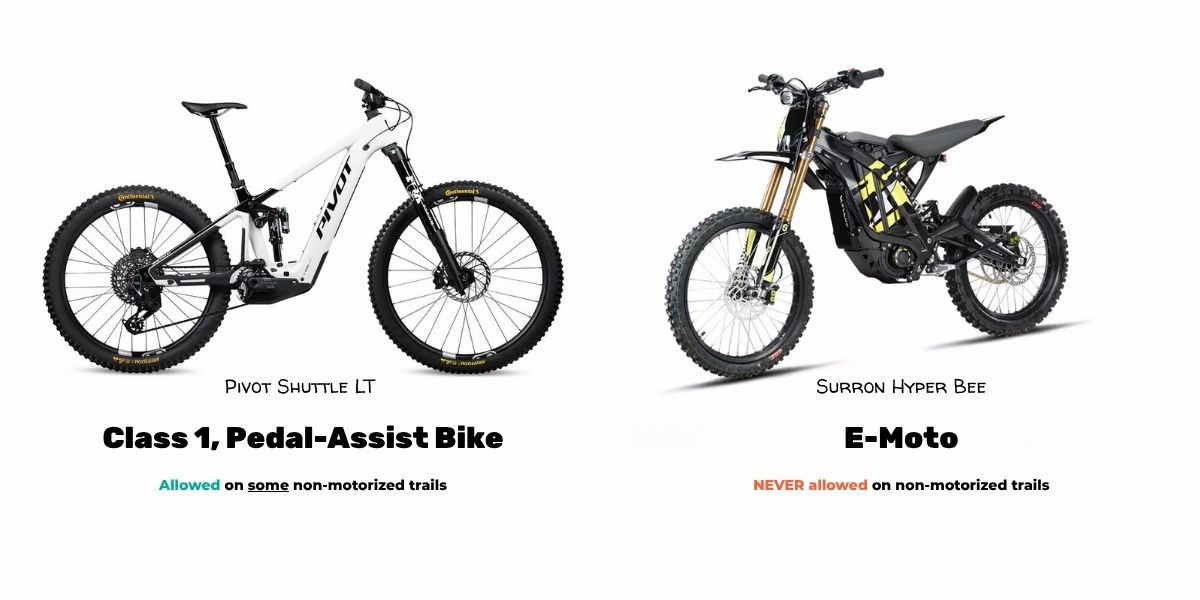
- E-motos (e.g. Surrons) are not e-bikes and are never allowed on non-motorized natural surface trails
- Class 1 pedal-assist bikes are the only type of e-bikes permitted on natural surface trails, unless motorized use is also allowed
- There are many networks on private and municipal land that currently allow for Class-1 pedal-assist access (link)
- All eMTBs, including Class-1 pedal-assist bikes, are currently prohibited on non-motorized trails on state or federal land, though FPR is reviewing public comment on a proposed updated policy that would allow for access
- Some manufacturers are pushing the speed and power limits for Class 1 pedal-assist bikes, confusing the designation and threatening existing and future Class 1 access
- Pedal-assist access is ultimately up to the land-owner or land manager, and respecting their policies is vital to retaining and expanding access for all mountain bikes
- When referring to e-bikes allowed on mountain bike trails, we attempt to use Class 1 pedal-assist language so as to better distinguish these bikes from those with a throttle, with assist beyond 20mph, or with motors with more than 750W of power
For basic definitions and FAQs, be sure to check out our Electric Mountain Bikes page.
The Growing E-Moto Threat
Over the past few years, dirt-bikes powered with electric motors have exploded in popularity. These e-motos, manufactured by brands like Surron, Talaria, and KTM Freeride, as well as many cheaper knock-offs, are categorically different vehicles and are not e-bikes. The latest Surron has 8,000W of throttle-driven peak power – over 10 times that of a conventional Class 1 pedal-assist bike – and can hit 30 miles per hour in under three seconds. In Vermont, these e-motos require motorcycle registration and endorsement to be ridden on public roads and OHV registration to be ridden on motorized trails (noting that many ATV trails in Vermont do not allow dirt bikes). Nonetheless, these e-motos are often marketed alongside or as e-bikes and sold to buyers who do not understand the classification or legal requirements. There is legislation in development at the Federal level, the Safe Speeds act, that would require the Consumer Product Safety Commission (CPSC) to clearly define categories for different types of products — including legal Class 1,2, and 3 e-bikes vs. illegal “e-motos” — and implement labeling requirements and minimum age recommendations.
Why should we be concerned about e-motos? First, uneducated consumers are increasingly showing up at mountain bike trail systems with these electric dirt bikes, damaging non-motorized trails and threatening the safety of themselves and others. Second, some policymakers are increasingly confused by the breadth of electronically-assisted and powered devices and simply choosing to lump them all (or mostly) together. The growing popularity of e-motos and unclassified e-bikes, combined with a lack of consumer education and clear regulations, has resulted in numerous deaths nationwide. In New Jersey, S4834/A6235 was signed into law this January, classifying all forms of e-bikes and e-motos as ‘motorized bicycles’ requiring registration. To legally ride a Class 1 pedal-assist MTB in New Jersey, you must purchase insurance and a license, be at least 15, present six points of ID, pass a written and vision test, and take a road test after holding a permit for at least 20 days.
Should you care if you don’t ride (or perhaps don’t like) pedal-assist mountain bikes? We believe you should. In addition to serving as important mobility devices for folks with physical limitations, Class 1 pedal-assist MTBs are increasingly difficult to distinguish from analog MTBs. It may become easier for trail managers to simply ban ‘mechanized’ use – anyone on a bike – rather than attempt to investigate whether or not a bike has an essentially ‘invisible’ motor.
The reality is that many folks – including regulators – now think of “e-bikes” as anything on two wheels with an electric motor. To help further emphasize the distinction between Class-1 pedal-assist bikes and all other types of e-bikes and e-motos, VMBA limits references to “e-bikes” and “e-MTBs” and uses the pedal-assist language instead wherever possible. We are also actively working with leaders from other state and regional trail organizations across the country to advance the adoption of the consumer regulations and protections described in the Safe Speeds act, either at the federal level or state-by-state if necessary. Much more on that to come.
Pushing the Class 1 Limits
Increasing the challenge of distinguishing Class 1 pedal-assist bikes from all other e-bikes is the recent introduction of models that blatantly push the classification power and speed boundaries. Federal law originally defined a “low-speed electric bicycle” as “a two- or three-wheeled vehicle with fully operable pedals, an electric motor of less than 750 watts, and a top speed when powered solely by the motor of less than 20 mph,” exempting treatment as a motor vehicle under federal law. The Class 1/2/3 definition was subsequently developed by People For Bikes, the nonprofit bicycle industry trade association, with 45 states now having adopted Class 1 language as a “bicycle equipped with a motor that provides assistance only when the rider is pedaling, and that ceases to provide assistance when the bicycle reaches the speed of 20 miles per hour.”
Until recently, the bicycle industry had respected the stated 20 mph assist cut-off for class 1 pedal-assist as well as the 750 watt limit in federal statute. Many brands are taking advantage of loopholes and vagaries in the law to produce pedal-assist bikes that exceed the intended limits for Class 1 bikes. Specialized’s latest eMTB offers a “Class 3 mode” with a 28mph assist limit, with the expectation that the user will ‘switch’ to Class 1 mode for trail use. In a much more extreme example, the latest motors from Avinox can provide up to 1500W of power – double the “limit” cited in Federal statute. How? By interpreting the law to mean maximum ‘continuous’ or ‘rated’ motor power – the power at which the motor operates without overheating, and allowing for peak power well above that limit. 1500W is more than two horsepower and under Vermont law, would push these ‘bikes’ out of even electric moped territory and into the ‘motorcycle’ classification on the road. Brands are selling and promoting these bikes as trail-legal, pedal-assist bikes, despite having access to dirt bike levels of speed and/or power. Not only do these bikes not belong on non-motorized trails, they threaten access for all Class-1 bikes.
While we would love manufacturers to ‘self-regulate’ and recognize the 750 watt threshold as a peak power limit, as MTB legend Hans Rey recently called for in an open letter to the bike industry, we are realistic in understanding how the free market works. There are some brands, most notably Bosch, that have been vocal about a hard cap for many reasons, including the threat of additional regulations on bikes that are approaching e-moto peak power as well as impacts on component wear and battery size & cost.
VMBA strongly believes the official Class 1 definition should include a peak power limit of 750W. We are working with other trail organizations throughout the country to advocate for this critical update to be made before more of these “Super Class 1” bikes are sold to consumers and then potentially prohibited for non-motorized trail use.
Where You Can Ride
Many trail systems in Vermont located on private and or town land allow Class 1 pedal-assist bikes. We have a full list on our website, and popular systems include Cady Hill, Saxon Hill, The Driving Range, Mt. Peg, Aqueduct, Pine Hill Park, Kingdom Trails, Ascutney Trails, and Slate Valley Trails. On the flip side, all e-bikes – including Class 1 pedal-assist bikes – are currently prohibited from non-motorized natural surface trails on state and federal land in Vermont.
On the state side of things, the Vermont Department of Forests, Parks and Recreation recently gathered public comments on a proposed update to their policy that would allow for all three classes of pedal-assist bikes on state park roads, Class A and B forest highways, gravel-surfaced Class C forest highways, and multi-use trails designated for bicycle use. It would also allow for Class 1 use on natural surface trails designated for MTB use. If the proposed policy is adopted, trail systems including Perry Hill, Little River, and Camels Hump State Forest would open to Class 1 pedal-assist bikes. They are, however, currently not allowed.
Similarly on U.S. Forest Service lands, all e-MTBs – including Class 1 pedal-assist bikes – are classified as motor vehicles under their Travel Management Rules. A 2022 rule allowed local land managers to designate existing non-motorized trails for pedal-assist use, but only after completing public input and environmental analysis through the National Environmental Policy Act. These trails also become ‘motorized trails,’ and while other motorized uses can be prohibited, the trail loses access to non-motorized funding and resources. All non-motorized mountain bike trails in the Green Mountain National Forest remain closed to pedal-assist bikes.
What it All Means
Our main goal is for those currently riding or considering a pedal-assist bike to educate themselves about both their equipment and where they plan to ride. If you are considering purchasing a bike that you intend to ride on mountain bike trails, work with a reputable bike shop and ensure that you’re choosing a Class 1 bike. Given the growing pressure to clarify the peak power rules for Class 1 bikes and the safety and mechanical wear issues posed by the latest crop of “super Class 1” bikes, we would strongly recommend avoiding models that either exceed 750 watts of peak power or 20 mph of e-assist.
Regardless of what bike you ride, we encourage everyone to do a little homework on where you plan to ride. You should always check for trail closures, conditions, and any other important information the trail manager chooses to share, like quiet zones, pet policy, etc.. Respectful use is key to retaining and growing access and a vital part of the Ride with Gratitude pledge.
For additional questions, be sure to take a look at our eMTB page and feel free to reach out if you can’t find the answers there, or have additional ideas you’d like to share.